Some links on this page may be affiliate links. If you buy through them, we may earn a commission at no extra cost to you, and this does not influence our ratings.
Choosing marketing automation software means weighing how deep its features go against the time, skills, and upkeep your team can realistically provide. The activecampaign pros and cons tell a clear story: a powerful engine that rewards careful planning. Here at Top App Review Sites, we test each capability against everyday business workflows so you can invest with confidence.
ActiveCampaign brings together email sequences, a customer relationship pipeline, and behavior-based tagging to nurture audiences in a structured way. Knowing both its advantages and its friction points helps you avoid surprises during rollout and get the most from every contact you manage.
Quick verdict: ActiveCampaign earns an 8.0 out of 10 from Top App Review Sites. It suits teams that need layered, multi-step workflows and one shared view of each contact across the sales stages. It is a poor fit for solo senders who only want simple one-off newsletters with minimal setup.
| Metric | Summary Details |
|---|---|
| Top App Review Sites score | 8.0 out of 10 |
| Best for | Teams running multi-stage contact nurturing and organized deal tracking |
| Not ideal for | Solo senders who only send basic monthly broadcasts with no automated segmentation |
| Key strengths | Visual workflow logic, contact lifecycle segmentation, and unified interaction histories |
| What to check before buying | Confirm seat counts, contact-tier thresholds, and required feature access on the official vendor site |
1. How Top App Review Sites Evaluated ActiveCampaign
This review examines what ActiveCampaign is designed to do, which users it serves best, and how it stacks up against comparable tools. We assessed it across seven criteria: features, ease of use, pricing and value, integrations, audience fit, support, and competitive position. Plans, prices, and limits change frequently, so always verify current details on the official website before purchasing. This article was researched and drafted with AI assistance, then reviewed and edited by the Top App Review Sites Editorial Team.
2. A Quick Overview of ActiveCampaign's Strengths and Weaknesses
Assessing ActiveCampaign means balancing deep behavioral automation against the upfront effort it demands. The platform combines email marketing, conditional automation paths, and deal tracking within one system.
On the positive side, you can build detailed automation sequences triggered by website visits, message engagement, and pipeline movement. On the other side, mastering conditional logic takes dedicated onboarding time, and new teams need to plan database upkeep carefully.
Within the wider marketing technology landscape, buyers often compare ActiveCampaign with Mailchimp, HubSpot, and Brevo. Each platform targets different priorities, from simple template-based campaigns to full enterprise lifecycle management.
3. The Advantages of ActiveCampaign

ActiveCampaign's practical value comes from its flexible sequence design and unified contact records. The sections below cover the main areas where the platform delivers real utility.
3.1. Advanced Workflow Logic and Automation Builder
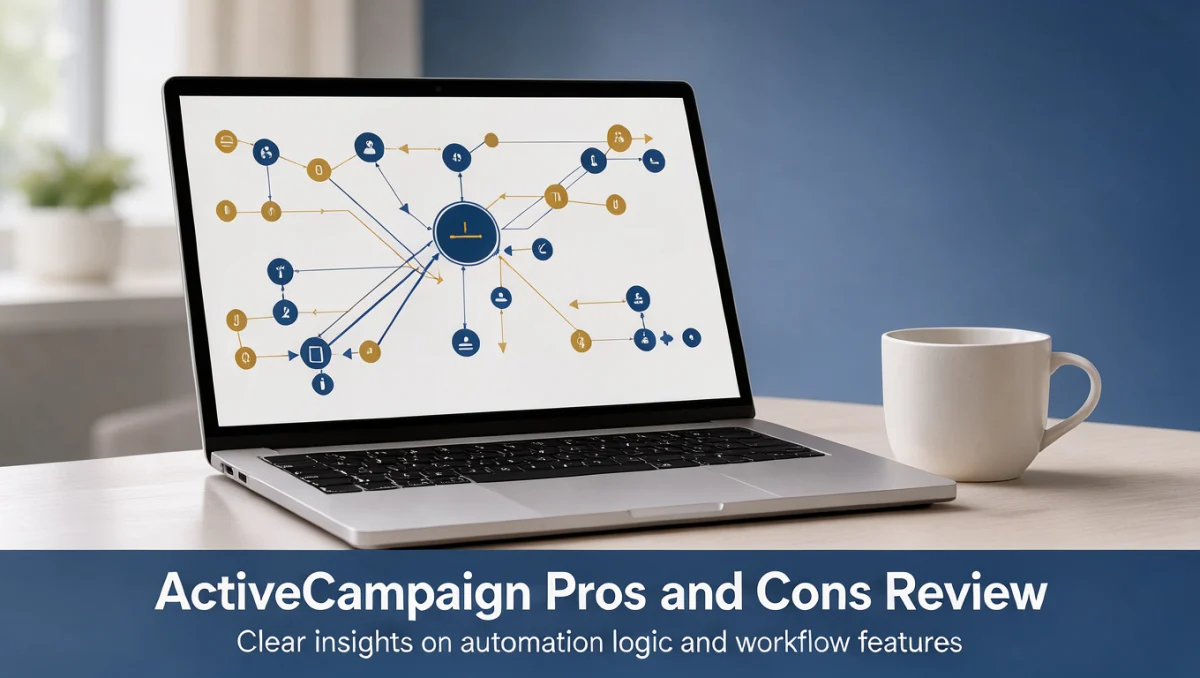
Workflow automation is ActiveCampaign's core strength. You can design branching journeys using multiple conditions, wait periods, goal checks, and custom webhook steps that guide each contact down a tailored path.
The visual builder maps full customer journeys across conditional splits, so teams can create nuanced onboarding sequences without writing custom scripts. Behavioral triggers respond directly to contact actions, updating profiles and launching follow-up messages automatically.
3.2. Precise Audience Segmentation and Dynamic Tagging
Audience organization relies on a flexible system of tags and custom fields. Marketers can apply tags automatically based on link clicks, page visits, and custom event markers.
This level of detail supports focused messaging that matches each subscriber's interests. Dynamic content blocks can change within an email depending on segment criteria, which removes the need to maintain duplicate campaigns for different audience groups.
3.3. Built-In Sales Pipeline Management
ActiveCampaign links marketing activity directly to deal stages. Sales teams can track outreach progress, review communication timelines, and assign tasks across customizable visual pipelines.
Automated processes can advance deals or create follow-up reminders when contacts show strong buying signals. This connection between messaging and sales tracking reduces friction during handoffs from outreach to qualification.
3.4. Unified Contact Event History
Each contact profile keeps a timeline of email opens, form submissions, page views, and notes. This shared record gives team members full context before reaching out.
Keeping complete history in one dashboard removes communication silos between staff members. Automated conditions can also check past behavior before deciding which message or task to trigger next.
4. The Drawbacks of ActiveCampaign
Although the feature set offers plenty of flexibility, several organizational hurdles come with implementation. Understanding these drawbacks early lets teams plan sensible workarounds.
4.1. A Steep Initial Learning Curve
The wide range of triggers, actions, and conditional rules makes early setup demanding for less experienced team members. Building nested automations without a clear plan can produce conflicting tags and broken delivery logic.
To reduce this risk, document your tagging structure and customer journey maps on paper before building workflows in the platform. Starting with simple linear automations before adding multi-branch conditions helps prevent structural errors.
4.2. Complex Navigation for Occasional Users
The number of options across settings, campaigns, contacts, and automation menus can feel overwhelming to people who only send periodic updates. Locating specific reports or segment settings may require digging through several nested submenus.
Teams can ease this by writing standard procedures for recurring tasks. Limiting administrative access and assigning dedicated managers to oversee campaign workflows keeps the interface manageable for general contributors.
4.3. Ongoing Administrative Upkeep for Database Quality
Tags and custom fields can multiply quickly, so keeping the contact database clean requires regular supervision. Left unchecked, duplicate tags and redundant segments pile up and cause confusion when selecting audiences.
Setting a routine for database hygiene solves this. Review active tags each quarter, archive outdated workflows, and enforce strict naming conventions for all new marketing assets.
5. ActiveCampaign Pros and Cons at a Glance
The table below summarizes the practical advantages and operational tradeoffs of adopting ActiveCampaign.
| Operational Category | Main Platform Advantage | Practical Limitation | Recommended Approach |
|---|---|---|---|
| Automation Architecture | Flexible multi-branch customer journey sequences | Complex rule sets can conflict without careful oversight | Map conditional logic on paper before building workflows |
| Data Management | Dynamic tagging and behavioral custom fields | Tag clutter builds up when tags are created without a plan | Enforce strict naming conventions and audit quarterly |
| Pipeline Alignment | Connected deal stages and automated task routing | Setup requires coordination across departments | Align marketing and sales definitions before setting triggers |
| Platform Usability | Deep control over every contact touchpoint | Steep onboarding curve for non-technical team members | Create standard workflow templates for recurring campaigns |
| Reporting Visibility | Detailed interaction histories on contact records | Aggregated reporting takes some platform familiarity | Bookmark core metric dashboards and export regular summaries |
6. Who Should Use ActiveCampaign

The right fit depends on your team's makeup, technical readiness, and message volume. Here is a look at who benefits most and who should consider other options.
6.1. Freelancers and Solo Operators
Independent professionals juggling client inquiries and product sales can use the platform to automate appointment reminders, lead qualification, and client onboarding sequences.
Freelancers who only send occasional quarterly announcements, however, may find the setup effort out of proportion to their needs. Simple newsletter services often deliver faster results for basic broadcasts.
6.2. Small Business Owners
Small business owners with dedicated client acquisition funnels gain a lot from automated lead nurturing and synchronized deal pipelines. The system keeps leads organized without requiring separate tools for outreach and basic customer records.
Owners should make sure at least one staff member has time to manage workflow rules and keep the database consistent. Without clear ownership, automated sequences can quietly fall out of date.
6.3. Marketing Specialists
Marketers running complex conversion funnels will find ActiveCampaign especially useful. The ability to test automation variants, segment by precise behavioral signals, and personalize message elements gives the control needed for steady growth.
Campaign managers can build lead-scoring models that flag qualified accounts for immediate team follow-up, making multi-channel outreach more effective.
6.4. Office Workers and Administrative Teams
Administrative staff handling customer communications, event registrations, and notifications can cut down manual follow-up work with automated triggers.
That said, internal messaging with no customer nurturing or relationship tracking does not justify an advanced automation platform. Standard collaboration and office tools handle internal communication with far less setup.
6.5. Students and Educational Users
Students studying digital communications can learn core concepts of marketing automation logic, lifecycle segmentation, and customer relationship management using the platform.
Running a live commercial database is rarely necessary for coursework alone. Educational users should check whether training materials or practice sandboxes meet their goals before committing to ongoing costs.
6.6. Teams That Should Look Elsewhere
Organizations that only need occasional one-off notifications or simple blast announcements without behavioral tracking should skip an intricate automation platform. Simpler newsletter tools deliver faster results with far less complexity in these cases.
Likewise, enterprises that need heavily customized database environments with specialized compliance frameworks should confirm whether a dedicated enterprise platform suits their scale better.
7. Frequently Asked Questions
What should buyers look for when comparing automation features?
Buyers should decide whether their communication process depends on static broadcasts or dynamic, behavior-driven paths. Platforms with visual sequence builders and tagging structures are best when prospects need multi-touch follow-ups, while simple broadcast tools are enough for basic announcements.
How should an organization plan for database growth?
Compare your projected list growth against the vendor's tier structure on the official ActiveCampaign pricing page. Because contact tiers shape ongoing subscription costs, regularly removing disengaged addresses helps keep your database clean and your budget predictable.
When is a dedicated onboarding period necessary?
Plan for dedicated onboarding whenever your team intends to build multi-branch workflows, pipeline stage transitions, or behavioral tagging rules. Setting aside time to define naming conventions and test triggers prevents delivery errors and conflicting automation paths.
What extra costs should teams budget for beyond the subscription?
Budget for asset creation, copywriting, list verification services, and staff training time. Checking add-on requirements, integration connectors, and specialized reporting needs on the official website helps avoid unexpected spending during rollout.
8. Final Verdict on ActiveCampaign
Our assessment positions ActiveCampaign as a comprehensive automation and contact management engine for growth-focused organizations. As covered throughout Top App Review Sites, choosing the right tool means weighing functional power against the effort required to implement it.
| Criterion | Score /10 | Reason |
|---|---|---|
| Features | 9.0 | Offers deep workflow logic, conditional branching, dynamic tagging, and integrated deal pipelines. |
| Ease of Use | 7.0 | Presents a noticeable learning curve and complex navigation for casual campaign creators. |
| Pricing and Value | 7.5 | Delivers solid returns for active funnels, though buyers must review tier thresholds carefully. |
| Integrations | 8.0 | Connects smoothly with common commerce, content, and form systems across standard stacks. |
| Audience Fit | 8.5 | Matches the needs of small-to-medium teams focused on systematic lifecycle nurturing. |
| Support | 7.5 | Provides documentation and direct assistance channels that buyers should confirm on the official portal. |
| Competitive Position | 8.5 | Holds a strong position against rivals like Mailchimp and HubSpot for automation-centric setups. |
Overall score: 8.0 out of 10
ActiveCampaign is a dependable choice for teams ready to invest time in structured marketing funnels, automated segmentation, and integrated deal handling. If your team only sends basic monthly updates, simpler newsletter software is the better match. If your strategy depends on automated, behavior-driven customer journeys, ActiveCampaign gives you the architectural control to execute them well.
For specific software selection questions or help configuring your marketing stack, contact the Top App Review Sites team at Top App Review Sites, or visit our Marketing category for more guides.