topappreviewsites may earn a commission when you buy through links on this page, at no extra cost to you. This does not affect our ratings.
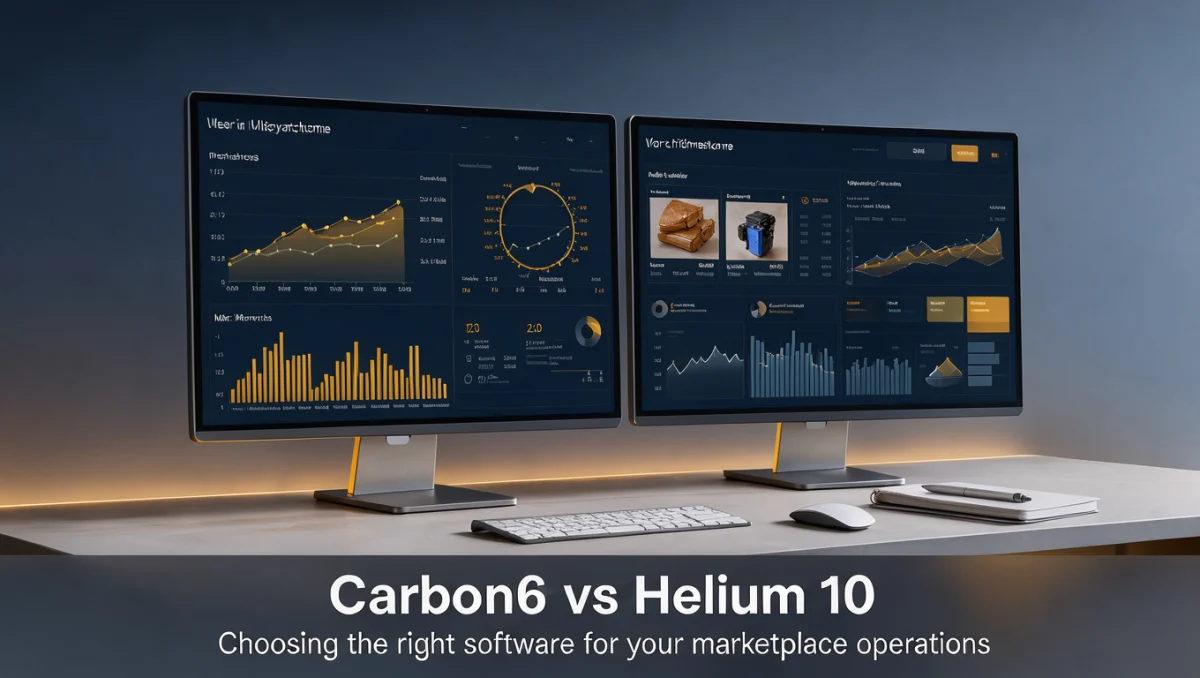
Picking between carbon6 vs helium 10 is a decision many marketplace merchants face when they need dedicated software for catalog management and advertising work. Knowing how each platform handles product research, profit tracking and inventory oversight makes it easier to match a tool to your daily workflow.
Our independent review at Top App Review Sites looks at operational focus, intended users and the evaluation steps you should take before signing up for either service.
Quick take: Carbon6 suits businesses that want modular operational tools and targeted reimbursement or analytics utilities, with an overall score of 8.1 out of 10. Helium 10 suits businesses that need an all-in-one suite for product discovery, keyword optimization and listing management, with an overall score of 8.4 out of 10.
| Evaluation Metric | Carbon6 | Helium 10 |
|---|---|---|
| topappreviewsites score | 8.1 / 10 | 8.4 / 10 |
| Best for | Growing brand operators who want targeted operational and financial tools | Active Amazon entrepreneurs who need an end-to-end research and optimization suite |
| Core focus | Operational efficiency, profit recovery and multi-tool merchant infrastructure | Product research, keyword intelligence and listing launch management |
| Consider if | Your brand already uses separate standalone apps and needs coverage for specific gaps | Your team wants one platform for daily marketplace growth tasks |
1. How topappreviewsites Compared Carbon6 and Helium 10
This comparison examines what Carbon6 and Helium 10 are built to do, who each one serves and how to choose between them. We assess them against seven topappreviewsites criteria: features, ease of use, pricing and value, integrations, audience fit, support and competitive position. Plans, prices and limits change frequently, so we flag what to verify on each official website before buying. This article was researched and drafted with AI assistance, then reviewed and edited by the topappreviewsites Editorial Team.
2. How Carbon6 and Helium 10 Differ in Focus
Carbon6 works mainly as an operational ecosystem for Amazon and marketplace sellers, grouping software aimed at profit recovery, advertising optimization and catalog analytics. It serves established merchants, private label brands and enterprise aggregators that want targeted tools for specific operational pain points without replacing every utility already in their stack.
Helium 10 is a broad platform covering the full lifecycle of an Amazon product, from early niche identification and reverse keyword lookup to rank tracking and inventory alerts. It is aimed mainly at independent entrepreneurs, private label creators and growing agencies that want one workspace for daily e-commerce activity.
3. Which One Fits Your Situation
The right software depends on your brand's maturity, existing tool stack and main operational bottlenecks. Looking at specific carbon6 vs helium 10 workflows shows where each vendor aligns most clearly with your needs.
| Situation | Choose Carbon6 if | Choose Helium 10 if |
|---|---|---|
| Launching initial private label products | You already have research tools and only need specific reimbursement support | You need niche discovery and search volume data in one workspace |
| Recovering lost inventory funds | Your team wants specialized audit tools built to spot carrier fee discrepancies | Basic account health monitoring covers your immediate needs |
| Optimizing existing listing keywords | You prefer specialized external data feeds for copy testing | You want integrated reverse search tools and listing scoring |
| Managing multi-brand agency accounts | You need modular components configured around specific client service tiers | You prefer onboarding clients into a standardized all-in-one dashboard |
| Auditing daily profit margins | Your main pain point is tracking complex warehouse fees and itemized operating costs | Standard gross revenue and basic expense reporting cover your weekly bookkeeping |
| Consolidating subscription costs | You are willing to use several specialized apps for specific team tasks | Leadership wants a single vendor covering team research duties |
4. How to Compare Them Yourself
4.1 Features
When testing marketplace software, check how well each system handles your core catalog data. Run live batches of ASIN records through both platforms to see keyword suggestions, historical trends and discrepancy detection, and confirm that data refresh rates fit your operating schedule.
4.2 Ease of Use
Have team members complete routine tasks, such as drafting an optimization or reviewing an advertising report. Count the steps needed to find key metrics and note where nested navigation creates friction for less technical users.
4.3 Pricing and Value
Subscription models in this category often change included seat counts, connected account allowances or data lookback windows. Confirm on the official Carbon6 and Helium 10 pricing pages how usage volumes, account connections and add-on features affect your total monthly cost.
4.4 Integrations
Merchant platforms depend on direct connections to regional seller marketplaces and advertising consoles. Check the official integration directories for both providers to confirm supported international marketplaces, third-party warehouse connections and data export formats before you commit data.
4.5 Audience Fit
Decide whether your business is an early-stage brand builder or an established multi-channel catalog manager. Compare your team's skills with the technical depth each system requires so you don't pay for capabilities your staff can't use.
4.6 Support
Review the documentation, help centers and onboarding paths each vendor publishes. Confirm available onboarding resources and escalation routes on the official provider sites so your team has enough guidance during setup.
4.7 Competitive Position
Consider how each platform holds its identity against alternatives such as Jungle Scout or Viral Launch. Carbon6 focuses on operational depth and financial optimization, while Helium 10 emphasizes unified market research and discovery workflows.
5. Cost Checklist for Both Tools
Software costs in the marketplace ecosystem often go beyond base subscription rates, since growth brings extra fees for seats, data frequency and account connections.
| Cost item | Ask about Carbon6 | Ask about Helium 10 |
|---|---|---|
| Account connections | Confirm whether multiple seller IDs or international tokens need separate add-on subscriptions | Verify how many connected seller accounts are included in standard plans |
| User access seats | Review seat allocation rules and ask how extra team logins affect monthly billing | Confirm how team logins and multi-user seats are structured on official pricing tiers |
| Data usage thresholds | Check whether advanced reimbursement audits or API calls trigger extra transaction fees | Verify query limits, keyword tracking caps and ASIN lookup quotas on higher plans |
| Historical data archives | Ask whether accessing sales or keyword history beyond standard periods costs extra | Confirm how many months of search volume and sales history remain accessible |
| Onboarding or setup charges | Ask whether dedicated setup help or data migration involves upfront consultation fees | Confirm whether guided training requires a premium onboarding package |
6. How to Decide
- Map your main operational problem, noting whether your biggest challenge is product selection, search visibility or internal profit leakage.
- Audit your current subscriptions to see which standalone tools your team already uses for keyword tracking, accounting and PPC automation.
- Ask your operations and marketing specialists whether they prefer one unified suite or targeted modular tools.
- Verify current account limits, token allowances and user seats directly on the official Carbon6 and Helium 10 websites.
- Run structured trials with the same product catalog on both platforms to compare output clarity and workflow speed.
- Choose the provider that resolves your most urgent operational constraint while keeping total software overhead predictable.
7. Frequently Asked Questions
Which platform is better for new sellers?
New merchants usually benefit from a structured suite that teaches core optimization steps and niche validation. Helium 10 gives a unified starting point for niche research and building first listings, while Carbon6 tends to deliver more value once sellers have active catalog data, complex inventory movements and recoverable fees.
Can both tools be used together?
Many established marketplace businesses keep active subscriptions with multiple software providers. A brand might rely on Helium 10 for daily keyword monitoring and listing copy while using Carbon6 utilities for specialized inventory reimbursement audits and detailed financial tracking across several regional marketplaces.
What should growing agencies verify before choosing?
Agencies managing client stores should review multi-account permissions, user delegation features and client reporting outputs. Check the official documentation for both platforms to confirm how permissions are separated between client brands and whether bulk account management needs a specific commercial agreement.
How difficult is it to switch between seller suites?
Switching seller software rarely disrupts live storefronts, because Amazon Seller Central remains the system of record. However, historical keyword rank data, custom keyword lists and saved audit logs do not transfer automatically between platforms, so they need manual export and reconfiguration during any change.
8. Final Verdict
Choosing between Carbon6 and Helium 10 comes down to whether your business needs targeted operational tools or a central growth platform. Teams that want modular operational depth will find Carbon6 well suited to resolving specific backend issues, while merchants who need unified keyword and product discovery workflows will get more day-to-day value from Helium 10.
| Criterion | Carbon6 score /10 | Helium 10 score /10 | Reason |
|---|---|---|---|
| Features | 8.4 | 8.8 | Carbon6 offers deep operational and recovery tools, while Helium 10 provides a broad end-to-end seller toolset. |
| Ease of use | 7.2 | 7.6 | Moving between separate modular apps takes onboarding effort, whereas a single workspace offers clearer navigation. |
| Pricing and value | Confirm before buying | Confirm before buying | Check included features, usage quotas and seat limits on each official pricing page before purchasing. |
| Integrations | Confirm before buying | Confirm before buying | Confirm marketplace connectivity and regional seller center support on the official vendor websites. |
| Audience fit | 8.6 | 8.5 | Carbon6 closely matches established brand operations, while Helium 10 fits active private label creators. |
| Support | Confirm before buying | Confirm before buying | Check official help center documentation, onboarding access and escalation channels before signing up. |
| Competitive position | 8.2 | 8.7 | Carbon6 holds a distinct niche in operational efficiency, while Helium 10 is strongly positioned in search research. |
| Overall score | 8.1 / 10 | 8.4 / 10 | Average of the scored qualitative criteria based on independent topappreviewsites evaluation benchmarks. |
Have a question about choosing software? Send it to the topappreviewsites team through our contact page or follow topappreviewsites on LinkedIn for new reviews and comparisons.