topappreviewsites may earn a commission when you buy through links on this page, at no extra cost to you. This does not affect our ratings.
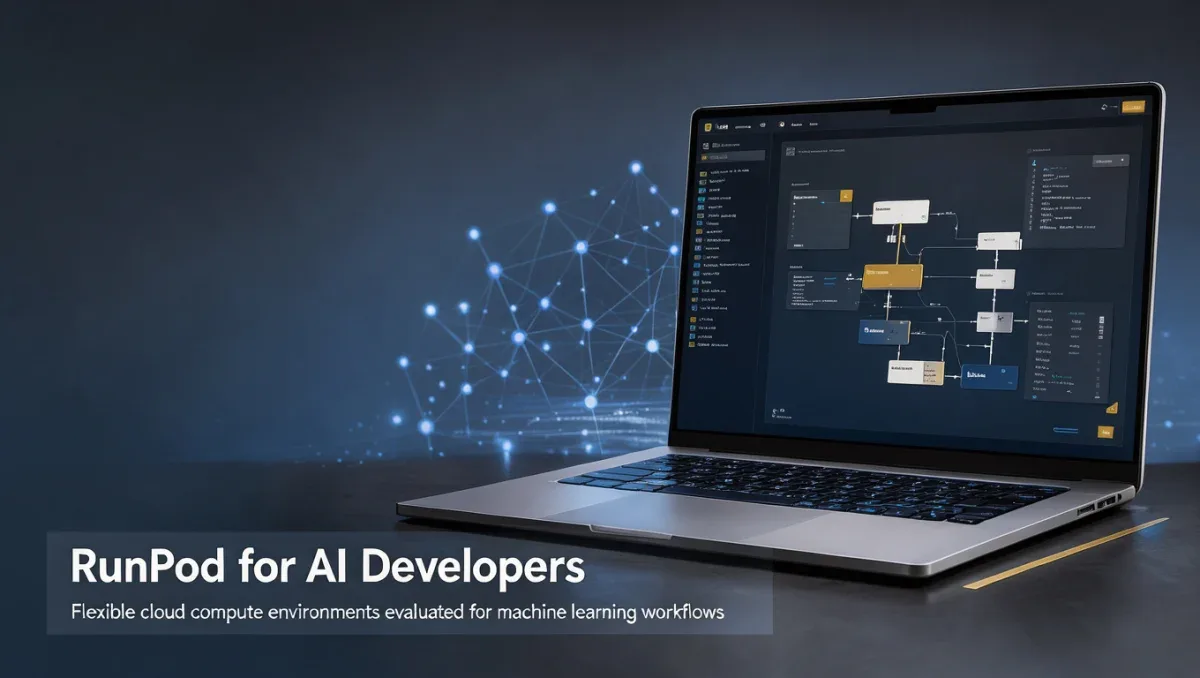
Engineering teams that build modern machine learning systems often need accelerated hardware without the burden of owning a data center. RunPod for AI developers is a compute platform built for training, fine-tuning and serving models on demand. At Top App Review Sites, we check how well such platforms fit real development workflows while keeping infrastructure simple to manage.
The compute environment you choose shapes how quickly projects move, what they cost to run, and how much operational work lands on your team. Independent engineers and early-stage founders need reliable runtimes that plug into automated pipelines and experimental code. Knowing what the platform does well, and where it stops, helps you spend development budget with more confidence.
Quick verdict: RunPod receives an overall score of 8.3 / 10 from topappreviewsites. It suits individual ML engineers and nimble development teams who want on-demand hardware for training and model hosting. It is less suitable for non-technical users, or for enterprises that need strict legacy compliance frameworks without hands-on technical oversight.
| Metric | Platform Assessment |
|---|---|
| topappreviewsites score | 8.3 / 10 |
| Best for | Machine learning researchers, independent developers, and AI startups |
| Not ideal for | Non-technical teams, beginner computer users, and organizations requiring managed system administration |
| Key strengths | Dedicated compute instances, container execution environments, and flexible deployment models |
| What to check before buying | Review instance availability, persistent storage billing policies, and network transfer rates on the official provider website |
1. How topappreviewsites Reviewed RunPod
This review examines what RunPod is designed to do, who it serves, and how it stacks up against similar tools. We applied seven topappreviewsites criteria: features, ease of use, pricing and value, integrations, audience fit, support and competitive position. Plans, prices and limits change frequently, so we flag the items you should confirm on the official website before committing. This article was researched and drafted with AI assistance, then reviewed and edited by the topappreviewsites Editorial Team.
2. What RunPod Is and Who It Serves
RunPod is a specialized cloud compute provider offering scalable hardware instances for accelerated computing workloads. It targets technical practitioners in the Artificial Intelligence space, including deep learning researchers, data scientists and backend engineers. Rather than maintaining local workstation hardware or navigating complex enterprise cloud bundles, developers use the platform to launch dedicated environments on demand.
The service gives builders direct access to accelerated infrastructure suited to heavy numerical computation. Its core audience includes developers who need fast turnaround during experimentation, model development cycles and continuous inference deployment, without waiting on lengthy hardware procurement.
3. What RunPod Helps You Do

Model training and experimentation
Engineers can launch dedicated instances preloaded with common deep learning environments and run iterative training scripts. Teams can verify package installations, load custom dataset archives and execute heavy pipelines without tying up local laptops.
Serverless inference execution
Developers can deploy standalone endpoints that handle inference requests programmatically. Production applications can route tasks through external APIs to generate model outputs without keeping idle virtual machines running around the clock.
Custom container deployment
Teams can run tailored container images bundled with specific dependencies, custom drivers and private code repositories. This keeps experiments reproducible while isolating development configurations from adjacent operational environments.
4. Ease of Use and Learning Curve
Specialized compute platforms demand an intermediate to advanced technical background, and RunPod assumes familiarity with standard engineering tools. Developers should be comfortable with terminal commands, container concepts, port forwarding and remote file transfer.
- Command line navigation: Building and running scripts assumes working knowledge of shell environments and version control.
- Container image configuration: Custom base images require an understanding of environment variables and software dependencies.
- Data synchronization: Moving large model weights calls for familiarity with remote file transfer protocols and cloud storage buckets.
- Network configuration: Connecting local machines to remote instances requires understanding secure connection keys and endpoint management.
5. A Two-Week Evaluation Plan for RunPod
- Days 1 to 3: Set up an initial test instance, verify a secure remote connection from your terminal, and confirm the environment meets your baseline execution needs.
- Days 4 to 7: Mount external storage volumes, run benchmark data loading operations, and measure how efficiently instances read your specific datasets.
- Days 8 to 14: Deploy a lightweight inference endpoint, run automated integration tests, and review accumulated charges on the official billing overview.
6. Where RunPod Shines and Where It May Fall Short
| Area | Shines when | May fall short when |
|---|---|---|
| Ad-hoc compute access | Researchers need rapid hardware for temporary model exploration | Teams require hardware reserved months in advance |
| Containerized operations | Engineers already have container setups ready to deploy | Beginners expect automated wizards to configure complex drivers |
| Development flexibility | Technical staff handle system tuning and environment optimization directly | Organizations depend on external managed services for operating system upkeep |
7. RunPod Compared with Similar Tools
| Tool | Best for | Core focus |
|---|---|---|
| RunPod | Agile engineering teams and technical builders | Flexible accelerated compute instances and serverless inference |
| Lambda | Deep learning researchers and model developers | Specialized machine learning cloud workstations and hardware clusters |
| Paperspace | Collaborative teams seeking visual notebook environments | Managed notebook workstations and machine learning model operations |
| AWS | Large enterprises with complex infrastructure requirements | Broad ecosystem of generalized enterprise cloud computing services |
8. Who Should Use RunPod
| User Segment | Recommendation | Considerations |
|---|---|---|
| Freelance machine learning engineers | Recommended | Suitable for intermittent client project testing and rapid prototyping |
| Independent AI startup teams | Recommended | Offers agile deployment models for shipping software without large infrastructure investments |
| Academic researchers | Recommended | Valuable for running modular scientific experiments within bounded project timelines |
| Non-technical team members | Not recommended | Requires technical fluency with shell environments, terminal commands and system administration |
9. Pricing at a Glance
- Verify current per-minute and per-hour compute rates directly on the official RunPod pricing page, since hardware rates shift with market availability.
- Check persistent volume storage policies to understand how idle volumes are billed when compute instances are stopped.
- Review network egress fees to anticipate ongoing data transfer costs when moving large model weights across regions.
10. Frequently Asked Questions
What technical background is needed to manage RunPod environments?
Developers need a practical grasp of command-line tools, remote shell protocols and containerization concepts. Because instances run as bare virtual machines or container runtimes, users manage dependencies and execution scripts directly rather than relying on automated visual interfaces.
How should teams handle sensitive development data on external compute instances?
Engineering teams should confirm storage encryption and access controls in the official platform documentation before uploading private code. Using ephemeral workspaces with separate external storage buckets helps keep sensitive datasets apart from individual compute instances.
What is a sound way to validate inference responsiveness?
Teams should configure test endpoints with smaller baseline models during early validation. Measuring response latency and memory use across varying request volumes gives realistic benchmarks before routing production traffic to live serverless endpoints.
When should an organization consider enterprise cloud providers instead?
Organizations should look at traditional enterprise cloud providers when internal compliance rules require extensive audit trails, unified billing across non-AI infrastructure, or specialized government certifications not offered by dedicated GPU clouds.
11. Final Verdict
| Criterion | Score /10 | Reason |
|---|---|---|
| Features | 8.6 / 10 | Provides capable compute instance management, custom container execution and responsive serverless endpoints |
| Ease of Use | 7.6 / 10 | Offers a clear operational layout but requires solid command-line and container administration skills |
| Pricing and Value | Confirm before buying | Review official instance rate cards and storage fees on the vendor website to judge overall cost fit |
| Integrations | Confirm before buying | Check official documentation to verify compatibility with your existing deployment and storage services |
| Audience Fit | 8.8 / 10 | Aligns closely with the workflow of modern deep learning engineers and computational researchers |
| Support | Confirm before buying | Examine available documentation and support channels on the official platform site |
| Competitive Position | 8.2 / 10 | Holds a distinct position as a fast, developer-focused alternative to complex legacy cloud providers |
| Overall score | 8.3 / 10 | Reliable, specialized compute platform built for technical builders and accelerated experimentation |
Engineering teams that need responsive access to computational hardware will find RunPod a nimble addition to their toolset. For more comparisons and independent software evaluations, visit Top App Review Sites to explore related development solutions.
Have a question about choosing software? Send it to the topappreviewsites team through our contact page or follow topappreviewsites on LinkedIn for new reviews and comparisons.